Nollywood Is Starving the Nigerian Imagination
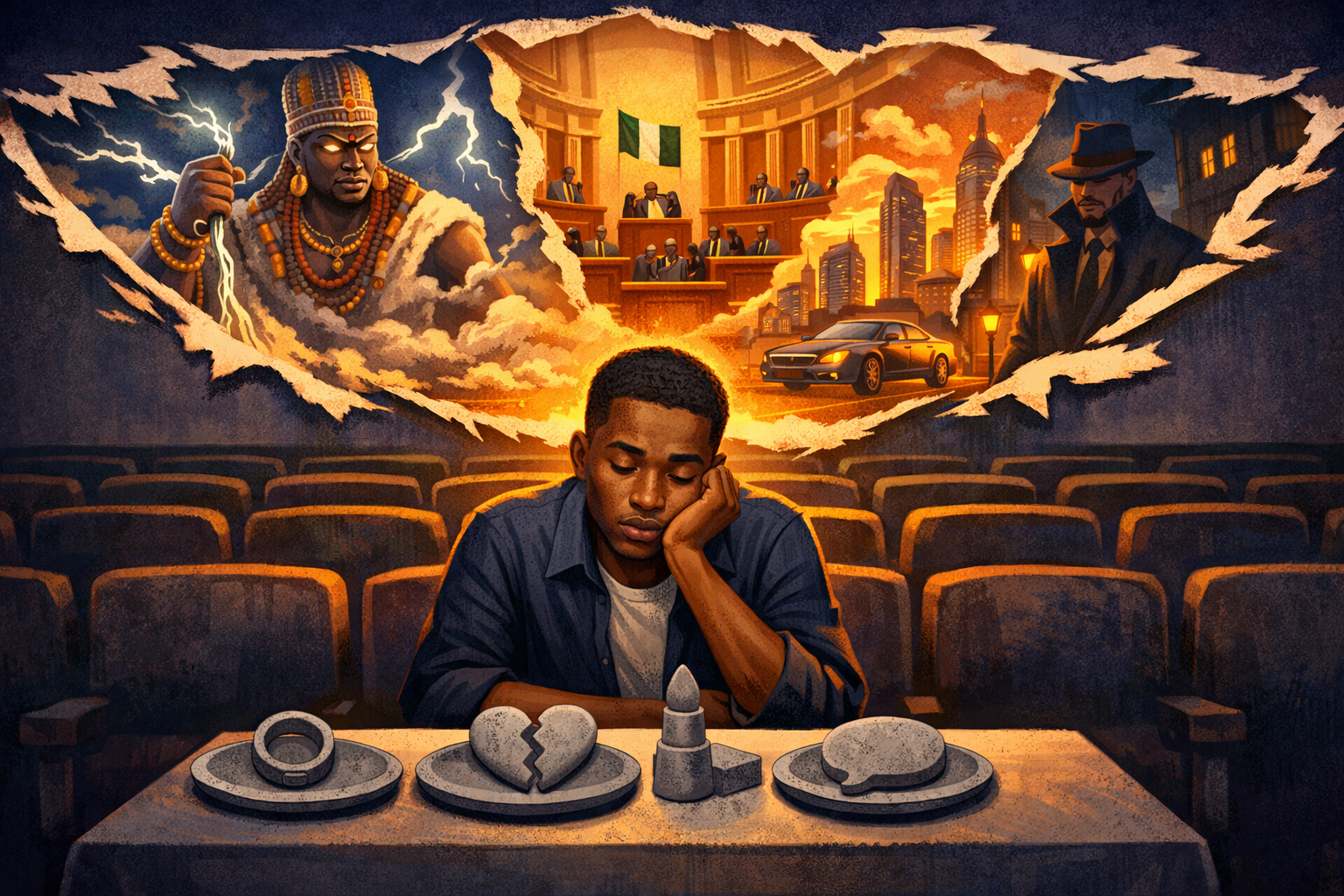
At this point, Nollywood is starting to sound like an industry that thinks originality is finding one more way to cram love, heart, wife, husband, or forever into a title. Love in Every Word. A Lagos Love Story. In the Name of Love. My Version of Love. Different wording, same bait.
Very often, you can guess the shape of the film from there. Someone is cheating. Someone is hunting for a husband. Someone is about to be humiliated in love. Someone is carrying a gender war into two hours of dialogue and calling it drama. The actors change. The wigs change(do they really?). The furniture changes. The imaginative range barely moves.
This is not me asking Nollywood to stop making love stories. Romance belongs in any healthy cinema. So do marriage, heartbreak, betrayal, desire, and domestic mess.
My complaint is about dominance. When those stories become the industry’s default setting, they start crowding out everything else: political thrillers, mythic cinema, speculative fiction, historical epics, children’s fantasy, stories about institutions, stories about power, stories about nationhood. A cinema that keeps returning to one emotional zone will eventually shrink the imagination of both its makers and its audience.
An industry as large as Nollywood should not feel this narratively cramped.
When I say Nollywood has an imagination problem, I mean that literally. I mean a shortage of narrative nerve. A shortage of world-building ambition. A shortage of respect for the audience. A shortage of patience for stories that are not optimized for the fastest possible payout.
That kind of shortage is a form of creative poverty, and I do not mean empty pockets. I mean poverty of ambition, standards, and creative courage.
Too much of what we make is built for the nearest possible money: YouTube money, quick streaming money, fast box office money, sponsor money, short-cycle cash.
And the issue is not that films end up on YouTube. The issue is what happens when YouTube logic starts shaping the imagination itself. Suddenly everything must announce itself in seconds. The title must bait instantly. The poster must signal scandal instantly.
The plot must feel familiar instantly. So the story is no longer being built for depth, memory, or rewatch value. It is being built for recognition, click-through, and fast emotional consumption.
When an industry keeps choosing the quickest profitable story over the deepest possible one, it trains itself into creative smallness. It loses the muscle for scale. It forgets how to build worlds people can live inside, and becomes very efficient at making things people can click on and forget.
That is a terrible trade.
The Quick-Cash Trap
Whenever this criticism comes up, the defense arrives quickly. This is what sells. People are stressed. The country is hard. Filmmakers have to make back their money.
Economics is real. Cash flow is real. Survival is real. None of that excuses creative surrender.
Hard countries do not need smaller imagination. They need bigger imagination. If reality is already punishing, why must fantasy also be poor? If we are failing in life, we must not fail in fantasy too.
The quick-cash mindset is not just a response to harsh conditions. It also deepens them. When everybody optimizes for the next payout, nobody builds the standards, story-worlds, or institutions that create lasting cultural power. We keep making things that can only survive in the short term, then wonder why we have not built anything durable.
This is true far beyond movies. It is true in business, media, careers, and art. I wrote in Good Enough Is the Enemy of Great that “good enough” is often more dangerous than obvious mediocrity because it does not trigger alarm.
Nollywood has become too comfortable with good enough: good enough plots, good enough dialogue, good enough stakes, good enough craft, good enough ambition. That is exactly why so much of it evaporates the moment you consume it.
People will answer that all this talk of ambition is romantic because for every person who dared and made it, many others dared and failed.
But that objection proves less than people think.
Failure is not evidence that ambition was foolish. It is often evidence that ambition without apprenticeship is common. It is the same point I made in You Want Originality Too Early: serious work does not come from vibes. It comes from study, standards, imitation of masters, and the discipline to keep going long after the market would have rewarded a cheaper version.
The answer to failed attempts at greatness is not retreat into mediocrity. It is better preparation for greatness, and sometimes it is simply more boldness.
People talk about great films as if they arrived stamped with inevitability. They did not. They often looked risky, excessive, delayed, strange, and commercially foolish while they were being made.
Look at Steven Spielberg’s Jaws.
Britannica notes that the film went badly over budget and schedule, with delays compounded by Spielberg’s decision to shoot on the ocean and by repeated failures of the mechanical shark.
Spielberg later said during a 2025 Academy Museum event, reported by the Los Angeles Times, that halfway through production he thought his career was basically over because people kept telling him he would never get hired again. And when the film finally came out, the L.A. Times’ original 1975 review hated it.
Now look at what happened instead. Jaws did not become a cautionary tale about ambition. It became one of the defining films in modern cinema.
Something can look like a disaster while it is being made and still become a breakthrough. Something can be mocked on arrival and still become canon. Something can fail commercially, critically, or both and still be worth making if it represented the artist’s best honest attempt at greatness.
So why are we so eager to pre-reject ourselves before the audience even gets the chance? Why do we keep treating novelty like a threat instead of a necessary cost of creative evolution?
Even when something new fails, there is more dignity in failing at your highest serious attempt than succeeding with disposable slop you never believed in.
We Learned America From Its Movies
One of the things Hollywood understood better than most film industries is that cinema does not merely entertain. It educates a people, and then exports that education.
Millions of people outside the United States understand, at least in outline, what the CIA is, what the FBI does, what the Pentagon represents, what a Senate hearing feels like, how covert operations are framed, how political cover-ups unfold, how the White House is staged, how prosecutors move, how intelligence briefings sound, how military chains of command are dramatized, and how American power imagines itself.
We learned a shocking amount of that not from textbooks, but from spy thrillers, political dramas, courtroom films, war movies, and prestige television. America dramatized its state so relentlessly that the world absorbed the grammar of American power by osmosis.
That is soft power. That is civic storytelling. That is cultural intelligence.
Now compare that with us. Where are the layered Nigerian films about Aso Rock, the DSS, EFCC, NNPC, customs networks, judicial bargaining, military procurement, church empires, campus kingmakers, civil service warfare, state elections, oil politics, intelligence games, and the machinery of Nigerian ambition itself?
Where are the great Nigerian political thrillers, the intelligence dramas, the courtroom films with teeth, the stories that teach Nigerians how Nigeria actually works?
Too often, we are fluent in who is cheating on whom and illiterate in how power moves. That is not a harmless gap. It is a cultural failure.
The Audience Excuse Is Lazy
I also do not buy the claim that the audience determines everything, at least not in the total way people say it.
The audience matters. The audience pays. But the audience does not always know what it wants before a serious artist shows it. People cannot consistently hunger in public for what they have rarely been offered with conviction.
Taste is trained by supply. Appetite is often created by exposure.
This is why the “give people what they want” argument does not survive much scrutiny. In How To Find Your Minimum Viable Audience, I argued that audience is not merely everyone with a pulse. It is the group whose worldview your work dares to serve. That matters because many builders and creators are too eager to obey shallow signals from the broad market when they should be shaping taste for the right people first.
If Hollywood had obeyed only obvious demand, Oppenheimer does not become a nearly $976 million global phenomenon. Black Panther does not become a $1.34 billion cultural event. Get Out does not turn a $4.5 million budget into more than $255 million worldwide. Ryan Coogler’s Sinners does not become proof that original, director-led cinema can still cut through in a franchise age.
The audience often discovers its desire after the work appears. Serious artists do not merely satisfy demand. They reveal it.
And locally, we have already seen small proof of it. Anikulapo traveled globally on Netflix because a mythic Yoruba-rooted story, treated with more seriousness than the usual betrayal loop, could hold attention beyond Nigeria.
In cinemas, films like Ajakaju and Lakatabu did not revolutionize anything. But they were enough to show that Nigerians will still buy tickets when the imaginative frame is wider than romantic betrayal.
The audience is there. It is under-served.
We Keep Simplifying the Story Because We Keep Simplifying the Viewer
There is another problem underneath all of this. Our movies are often too simplistic to carry themes within themes. Too many of them pick one theme and sit on it until the credits roll: love, sex, cheating, marriage panic.
But great stories do not breathe that way.
Great stories have pressure on multiple levels at once. They carry plot tension, character tension, moral tension, class tension, spiritual tension, political tension.
The external conflict means one thing. The emotional wound underneath it means another. The society around the characters means something else again. The symbols and setting are quietly doing their own work too.
That is why the best stories feel alive after they end. They are carrying more than one argument at once.
I think part of our problem is that we write as if the average Nigerian is too simplistic for that kind of density.
I reject that completely.
Nigerians are not simplistic. We are living inside one of the most layered countries on earth. We understand subtext in politics, religion, class, tribe, money, family, and survival almost instinctively. We gossip in layers. We worship in layers. We decode status in layers.
What we often lack is not audience intelligence, but creative respect for the audience.
Media scholar Jason Mittell, writing about why television storytelling became more complex, argues that the storytelling palette is broader than ever and that shows using dual timelines, shifting perspectives, and self-conscious narrative devices have become normal rather than exceptional. That matters because it kills the old excuse that mass audiences can only follow simple, single-thread stories.
They can follow complexity. They already do.
Inception was not just a film about dreams. It was also about grief, guilt, memory, fatherhood, corporate warfare, and the unstable border between reality and desire. It still made about $839 million worldwide.
Black Panther was not just a superhero film. It was also about monarchy, diaspora, isolationism, vengeance, inheritance, and the moral argument between reform and revenge.
Get Out was not just horror. It was also satire, racial allegory, social diagnosis, and psychological entrapment.
That is what themes within themes means: the surface story moves, but underneath it other stories are moving too.
That layering is not decorative. It is what gives a story rewatch value. It is what makes people argue about it, return to it, teach it, and remember it.
And this is not only true in film. Look at music.
In an era where people keep saying audiences only want the simplest possible thing, here is Jacob Collier making harmonically dense, structurally adventurous, joyfully strange work on a huge scale and still winning.
The Recording Academy says Jacob Collier has won seven GRAMMYs, and in its write-up on Djesse Vol. 4 it describes his work as an odyssey through genre, praises his “refusal to distill abundance,” and notes that the project used about 150,000 voices, many drawn from his own concert audiences.
Weirdness is not the enemy. Density is not the enemy. Layering is not the enemy.
The real enemy is making small work because you have already decided the audience is small-minded.
Once you assume the viewer is shallow, you start writing shallowly. Once you assume they cannot follow complexity, you stop building it. Once you assume they only want one-note emotional bait, you stop respecting their imagination.
And then, after years of feeding them simplification, you point at the simplification you helped produce and call it audience preference.
That is dishonest. The audience did not do that alone. The creators trained them there.
Thor Gets a Franchise. Our Gods Get a Warning Label
The contradiction gets even stranger when you look at mythology. The West can take Thor, pull him from Norse tradition, place him inside a cinematic universe, and sell him globally for years.
Marvel itself notes that through its 85-year history, most of its heroes and villains debuted in comics before taking on another life on screen. That is what strong creative ecosystems do. They build mythic reservoirs, then adapt them.
Disney’s collaboration with the Pan-African comic company Kugali on Iwaju, a futuristic Lagos story, makes the point plainly: someone else was willing to treat African imagination as the foundation of a serious world, not just as decoration.
So why do we still behave like our own gods must enter the room apologizing? Why must our metaphysics always arrive under suspicion? Why can Thor carry a hammer without scandal while Sango is often reduced to threat? Why is Ogun flattened into menace? Why are our orishas so often treated as dark symbols instead of complex presences inside a moral world?
UNESCO’s writing on the Ifa divination system and the Osun-Osogbo sacred grove is useful here because it states plainly that colonial rule and religious pressure encouraged discrimination against these traditions. That is not a small detail. It explains part of the imaginative wound.
We inherited a colonial reflex that made our own symbolic archive feel embarrassing while Western myth was repackaged as prestige, fantasy, or franchise.
That is not theology. It is colonized imagination.
And an industry afraid of its own metaphysical inheritance will always remain smaller than it should be.
The Problem Starts Upstream on the Page
The problem also runs deeper than movies. Cinema does not grow in a vacuum.
Many of the great story-worlds that shaped modern popular imagination started on the page before they moved to the screen. Harry Potter. The Lord of the Rings. A Song of Ice and Fire. Percy Jackson. Marvel comics. Manga. Graphic novels. Folklore archives. Fantasy series children can grow up inside before Hollywood arrives to industrialize them.
Bloomsbury says the Harry Potter books have sold over 600 million copies. Marvel openly says most of its major heroes were comics first. Rick Riordan’s official site describes Percy Jackson as a series adored by millions of young readers before adaptation expanded the franchise again.
That is the pattern: books first, adaptations later; world-building first, spectacle later.
This is why I do not think Nollywood’s problem begins and ends with producers. It is upstream too. It is literary. It is educational. It is cultural.
Where are our sprawling fantasy novels? Where are our Nigerian comics with true scale? Where are our detective universes, speculative children’s books, political thrillers, military novels, supernatural sagas, and historical epics that can mature into film ten years from now?
And let me make that more concrete. Why can we not get a saga with the depth people found in Game of Thrones, but drawn from our own archive of power, kinship, betrayal, cosmology, and war? I do not mean a lazy copy with African costumes and palace intrigue pasted on top.
I mean a story with true dynastic scale: competing houses, sacred obligations, succession crises, warrior codes, trade routes, priests and prophets, mothers, kings, traitors, generals, gods, land, blood, and memory all pressing against one another at once.
That is what made Game of Thrones feel large to people. Not merely dragons or violence, but the sense that private desire, public power, ancestral history, and metaphysical fear were all tangled together.
We have more than enough material for that kind of storytelling. Our kingdoms, empires, court politics, spiritual systems, colonial fractures, and family structures are dense enough to carry a saga of that scale. What keeps failing is not the material. It is the confidence, apprenticeship, and institutional patience required to build a world large enough to hold it.
And I do not mean this as lazy nostalgia. I am not saying Nigerian literature is dead. That would be false and unserious.
The British Council’s Publishing Futures report makes clear that Nigeria’s publishing sector still has enormous promise, but it is constrained by inflation, piracy, high production costs, poor reading culture, inadequate infrastructure, weak distribution, and limited investment.
A 2025 Associated Press report on a reading marathon in Lagos points to the real problem more clearly: the appetite is not dead, the ecosystem is weak. People still reach for books, but access remains thin, millions of children are still out of school, and the reading culture that should be feeding future writers, adapters, and world-builders is not as strong as it should be.
So the problem is not that Nigeria lacks imagination or talented people. The problem is that the pipeline from imagination to page, and from page to screen, is weaker than it should be for a country this large.
This is the same lesson I ran into while trying to build Africa’s AI: thin upstream inputs eventually produce shallow downstream outputs. Cinema is no different. When the reservoir of books, comics, myths, and serious story-worlds upstream is thin, the films downstream keep circling the same few plots.
That is where we are: too much loop, not enough reservoir.
Movies Mold People Whether We Admit It or Not
Some people still talk about movies as if they are harmless diversion. They are not.
Stories mold people whether the storytellers intend it or not. Scholars of narrative persuasion have shown that stories can lower resistance and shift beliefs. A study on An Inconvenient Truth found increases in knowledge, concern, and willingness to reduce greenhouse gases among viewers. The public backlash after Blackfish hit SeaWorld’s attendance and revenue hard enough that the company was forced into reputational defense.
Stories do not merely reflect culture. They move it. Which means every film industry is educating its people whether it means to or not.
I once came across a Voyage LA interview with performer Melissa Meliha where she described watching Moana and finally giving herself permission to pursue the entertainer’s life she had been postponing. You do not have to romanticize Disney to see the force of that. A film can do more than distract. It can clarify a buried calling and make a bolder life feel suddenly possible.
That too is what cinema is for.
So what exactly is Nollywood educating us into?
Too often, Nollywood trains us in the little techniques of emotional manipulation: how to deceive, how to suspect, how to test loyalty badly, how to turn every relationship into a battlefield of vanity, panic, insecurity, and reaction.
We are becoming fluent in betrayal.
What are we becoming fluent in beyond that? Where are the films that make Nigerians more historically awake, more politically literate, more imaginatively ambitious, more metaphysically curious, more intellectually alive?
Where are the films that enlarge instead of merely agitate?
A Serious Nollywood Would Be Larger Than This
UNESCO has described Nollywood as one of the world’s largest film industries, producing around 2,500 films a year. That is not small output.
Which is exactly why the imaginative narrowness is so frustrating. An industry producing that much should not keep feeling this small.
We need love stories, yes. But we also need Nigerian political thrillers, intelligence dramas, courtroom films, detective films, speculative fiction rooted in our own cities, campus movies with ideology and danger, corporate warfare stories, serious historical epics, mythic cinema that does not approach our gods like contraband, children’s fantasy, and literary adaptation.
We need movies that teach Nigerians how power works, how history breathes, how institutions rot, how faith corrupts and redeems, how money rearranges morality, how technology mutates class, and how ambition can build or destroy a nation.
In short, we need a cinema big enough for the country we keep claiming to be.
Build Worlds Again
I am not asking Nollywood to become Hollywood. I am asking it to stop playing this painfully small game.
We have scale. We have actors. We have history. We have politics. We have religion. We have folklore. We have cities dense enough for noir, villages old enough for myth, elites corrupt enough for thriller, and a people dramatic enough for every genre known to man.
What we do not yet have in enough concentration is the nerve to build at the level our material deserves.
That is the real issue: not absence of stories, but absence of nerve, patience, apprenticeship, and standards strong enough to resist the seduction of quick cash.
A country that cannot imagine itself deeply will eventually only consume itself shallowly, and a film industry that keeps shrinking itself to the same narrow emotional loop will not only fail artistically. It will fail nationally.
Nigeria deserves a cinema that can thrill, educate, mythologize, frighten, enlarge, and civilize. We deserve films that teach us our own country, recover our gods without shame, give our children Nigerian worlds in which to imagine themselves, and make serious ambition feel honorable again.
And let this also be a call to the writers, directors, and producers sitting on ideas they fear are too strange, too ambitious, too local, or too unlike what is currently selling: make them anyway. Be different. Be weird in the serious sense. There is always room for unusual work when it is shaped with craft, conviction, and form.
Nollywood must stop merely monetizing attention and start building imagination, because a country that does not build worlds on the page and on the screen will keep renting its dreams from abroad.