Git Flow Worked For Me. Agents Need Something Faster.
I liked Git Flow for a very specific reason.
I am often a team of one.
Even when I am maintaining open source in public, the day-to-day reality is still me carrying most of the operational weight: building the feature, testing the change, cutting the release, and living with the consequences if I rushed something dumb into the stable branch.
In that world, Git Flow gave me something that felt deeply practical:
- one branch that stayed hot
- one branch that stayed stable
For me, develop was the hot lane.
That was where I could test ideas, let unfinished work breathe a little, and shake out the rough edges without pretending it was already production-ready. main was the boring lane. Once something landed there, I wanted to feel calm. I wanted to know it was stable.
As a solo builder and open source maintainer, that separation was not theoretical. It was useful.
It meant I could keep moving on the next thing without making the stable branch feel like my workshop floor after a long night.
So when I say Git Flow worked for me, I mean it.
Not in the abstract.
In my actual day-to-day work.
Why It Eventually Started Feeling Expensive
The problem is that Git Flow buys safety with ceremony.
That trade-off can be worth it. Sometimes it is exactly the right trade-off. But the cost does not disappear just because the workflow has a nice diagram.
You pay for it in branch choreography:
- feature into
develop - release off
develop - release into
main - release back into
develop - hotfix into
main - hotfix back into
develop
If you are a big team shipping versioned software with long stabilization periods, maybe that cost is justified.
If you are a fast-moving product team, a solo maintainer, or an open source operator who wants to ship in smaller batches, that cost starts to feel like paying coordination tax to coordinate with yourself.
This is not even a controversial take anymore.
Vincent Driessen, who wrote the original successful Git branching model, later added a note saying the model was conceived in 2010 and that teams doing continuous delivery should use something simpler such as GitHub Flow.
That matters.
Because it clarifies something people miss all the time: Git Flow was never supposed to be the final law of software development. It was a fit for a certain environment.
And for a lot of modern software, that environment is gone.
The Limitation I Felt Most As a Team of One
Here was the real issue for me.
Git Flow gave me a hot lane and a stable lane at the repository level.
But I no longer wanted isolation at the repository level.
I wanted isolation at the task level.
That is a big difference.
develop works when you are comfortable pouring all unfinished work for “what comes next” into one long-lived branch.
But that branch becomes a warehouse.
It accumulates unrelated changes.
It becomes a place where half-finished ideas sit beside almost-ready fixes.
It turns the question “what is ready?” into archaeology.
And as a solo maintainer, that gets old fast.
release/* branches started feeling like ritual around work I could often express as a version bump, a final check, and a tag.
hotfix/* branches started feeling like urgency with a fancier name.
And develop started feeling less like freedom and more like inventory.
That is before AI even enters the picture.
Then AI Changed the Unit of Work
AI did not make me want less discipline.
It made me want a different kind of discipline.
Now I can have one agent exploring a refactor, another drafting docs, another testing a fix, while I review the work, redirect it, or throw half of it away.
Even without AI, fast coders already live this way in miniature:
- one terminal for the app
- another for tests
- another for a risky experiment
- another for a bug fix you do not want tangled into the first thing
The branch model that fits that world is not a grand taxonomy of develop, release/*, and hotfix/*.
It is a stable mainline plus cheap, isolated work lanes.
That is the shift.
The thing I loved about Git Flow was the separation between hot and stable.
The thing I need now is that same separation, but scoped to each task.
GitHub Flow And Trunk-Based Development Pointed The Way
The broader industry has been moving this direction for a while.
GitHub’s own docs teach a simpler shape: main is the definitive branch, you branch off main, do the work, open a pull request, and merge back into main.
Trunk-based development pushes even harder. The guidance around short-lived feature branches is blunt: branches should live briefly, merge quickly, and be deleted. If a branch hangs around too long, it starts becoming the very thing trunk-based development is trying to avoid.
That maps cleanly to how I want to build now.
Not because I suddenly became ideologically minimal about Git.
Because I want less stale inventory living in branches.
I want main to mean something.
I want unfinished work isolated by task, not dumped into one perpetual “next release” branch.
What Git Vibe Changes
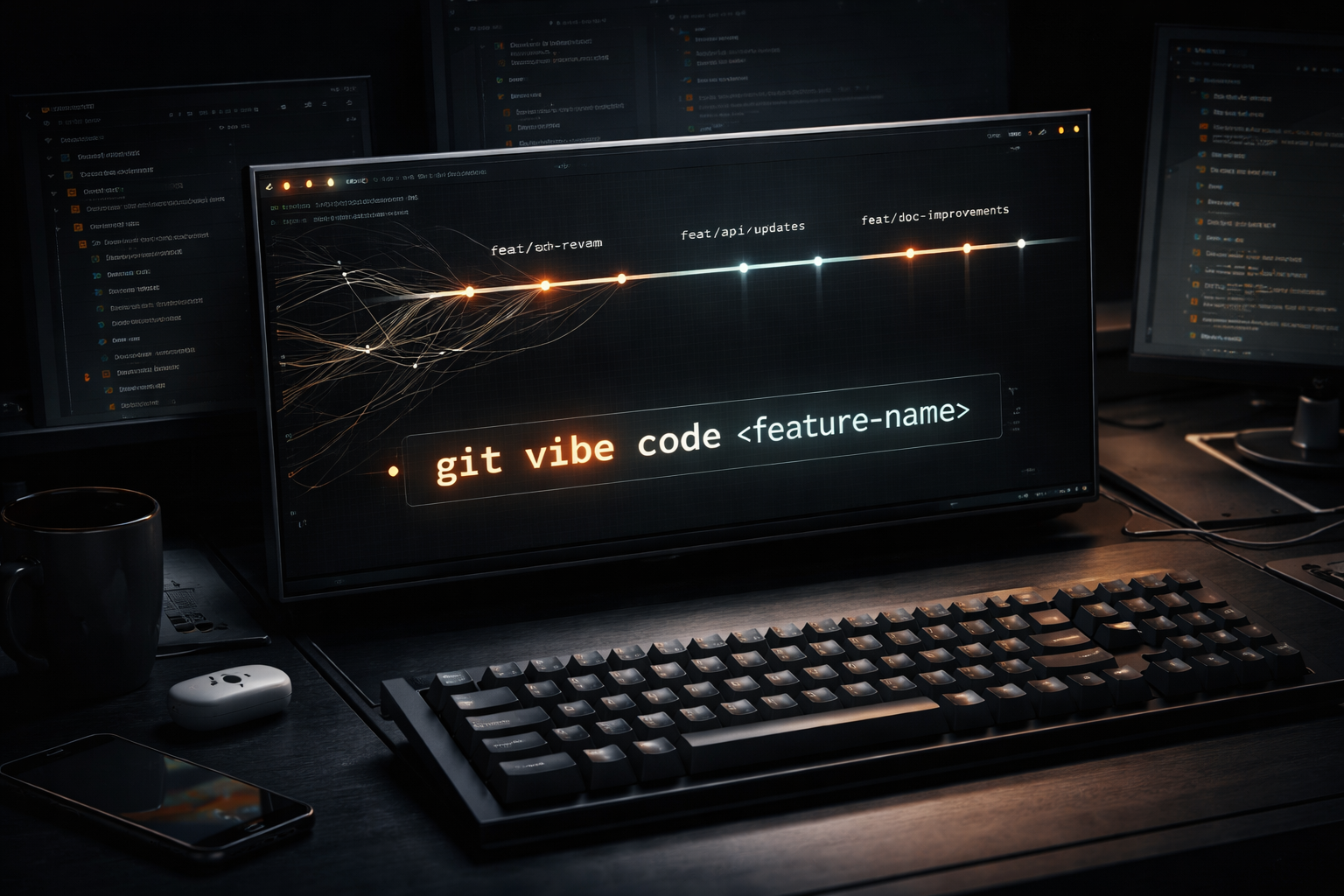
That is why I built Git Vibe.
Git Vibe keeps the part I liked from Git Flow and changes the part that now feels too expensive.
The model is simple:
mainis the only long-lived branch- every piece of work lives under
feat/* - every
feat/*branch gets its own worktree - releases are cut directly from
main
That is the whole idea.
No develop.
No release/*.
No hotfix/*.
No giant holding pen for unfinished work.
Instead, every task gets its own lane.
How Git Vibe Actually Works
Start from a clean main checkout.
Run:
git vibe code add-billing-webhookGit Vibe creates a short-lived branch called feat/add-billing-webhook and checks it out into its own worktree, usually under ../.vibe/<repo>/add-billing-webhook.
That sounds like a Git detail. It is not.
It means that one task now has its own:
- folder
- terminal
- editor window
- test run
- dev server
- agent context
If I need another piece of work, I do not pollute the first lane. I open another one.
git vibe code fix-login-timeout && git vibe code write-launch-postNow each task lives in its own room.
Not its own pile in the same room.
That is the crucial distinction.
If I rerun git vibe code add-billing-webhook, Git Vibe reopens the same worktree instead of creating a duplicate. So the lane is persistent while the work is active, but disposable once the work is done.
When the branch is merged locally, I run:
git vibe finish --local add-billing-webhookThat fast-forwards main, removes the worktree, and deletes the feature branch.
If the branch was merged through GitHub, I run:
git vibe finish --sync add-billing-webhookThat fetches origin/main, confirms the merge, fast-forwards local main, and then cleans up the worktree and branch.
Releases stay boring too:
git vibe release 0.0.2 --pushThat cuts the release directly from main with a version bump commit and an annotated tag.
Git Vibe also adds light guardrails around the workflow. It can block casual commits on the base branch, enforce semantic commit messages, and keep main from slowly turning into a scratchpad.
In other words, Git Vibe moves the hot lane down from one long-lived develop branch to many short-lived task lanes.
That is the whole point.
Why This Fits Agents And Fast Coders
Git Vibe is not only for AI agents.
It is for anybody who wants to move quickly without smearing work across the same checkout.
The agent angle just makes the need more obvious.
When every task has its own worktree by default:
- one agent can refactor safely
- another can write docs safely
- another can debug a test safely
- and none of them have to step on each other in the same working tree
But the exact same benefit applies to a human coder moving fast.
You do not need AI to benefit from not branch-hopping, not stashing all day, not wondering which half-finished change belongs to which idea, and not restarting your mental context every 20 minutes.
Git Vibe is simply Git organized around velocity with isolation.
Not velocity with chaos.
The Real Upgrade
Git Flow gave me a hot lane and a stable lane.
I am grateful for that.
But I do not need a cathedral of branches anymore.
I need a boring mainline and cheap rooms for unfinished work.
I do not want one long-lived hot lane for everything that is not ready.
I want a stable lane and many short-lived hot lanes, each tied to a single task, each easy to open, each easy to finish, each easy to delete.
That is a better match for how I actually build now:
- as a team of one
- as an open source maintainer
- as someone who wants
mainto stay trustworthy - as someone who wants unfinished work isolated by task
- as someone who increasingly works with agents and parallel attempts
The old model separated stable from unstable.
The new model separates task from task.
That is a better abstraction.
Git Flow Worked For Me. Git Vibe Fits Me Better.
I did not build Git Vibe because I wanted a clever new Git wrapper.
I built it because I wanted to keep the feeling Git Flow gave me without paying the branch tax Git Flow demands.
I still want main to feel stable.
I still want room to test new work.
I still want discipline.
I just do not think the right place for that discipline is a permanent develop branch anymore.
I think it belongs in a boring main, short-lived feat/* branches, and isolated worktrees that disappear when the job is done.
That is the workflow I wanted as a solo maintainer.
It is the workflow I want even more in the age of agents.
Git Flow gave me one hot lane and one stable lane.
Git Vibe keeps the stable lane and gives every task its own hot lane.
That is the upgrade.